
OOP in the AI Era
AI copilots can now generate substantial program code directly from natural-language prompts. This capability changes how software is developed, but it does not reduce the importance of programming knowledge. Developers must still express design intent clearly, evaluate whether generated code is correct and well structured, and refine it into reliable and maintainable software.
Object-oriented programming is particularly important in this environment because its principles and constructs provide a foundation for understanding, evaluating, and improving AI-generated code.
Why OOP Still Matters
Object-oriented programming provides systematic ways to organize software around objects that combine state and behavior. Its core principles—encapsulation, information hiding, abstraction, inheritance, polymorphism, and composition—help developers manage complexity and create software that is modular, reusable, extensible, and maintainable.
These principles are also valuable when working with AI-generated code. A copilot may generate code that is syntactically correct but still contains weak class structures, inappropriate inheritance, poor information hiding, excessive coupling, or incomplete domain logic. OOP knowledge enables developers to recognize these weaknesses and improve the resulting software.
OOP Ubiquity
Object-oriented concepts extend well beyond programming language constructs. As illustrated below, the object-oriented paradigm is embedded across software development practices and reusable software assets, including languages, libraries, frameworks, platforms, design methods, design patterns, architectural styles, reference models, cloud systems, and microservices.
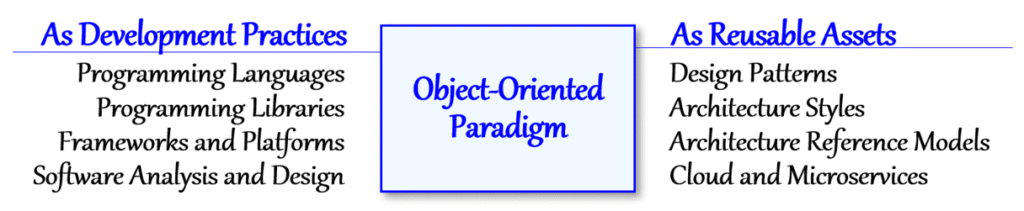
The object-oriented paradigm is ubiquitous across software engineering, appearing both in development practices and in reusable software and architectural assets.
Programming Knowledge in the AI Era
AI-generated code should be regarded as a candidate solution rather than a final product. Developers remain responsible for determining whether the code satisfies requirements and meets appropriate quality standards.
Programming and OOP knowledge are essential for several reasons:
- Understanding and validating generated code — Developers must verify correctness, completeness, security, and adherence to object-oriented principles.
- Customizing AI-generated solutions — Generated code often requires refinement to match domain requirements, architecture decisions, coding standards, and performance needs.
- Selecting appropriate OOP constructs — Developers must decide when to use classes, composition, inheritance, interfaces, abstract classes, polymorphism, generic classes, and other mechanisms.
- Improving software quality — AI-generated drafts may need stronger encapsulation, clearer responsibilities, reduced duplication, better abstractions, or more appropriate object relationships.
The role of the developer therefore shifts from writing every line manually to guiding, evaluating, and improving code produced with AI assistance.
AI Copilots for Object-Oriented Development
AI copilots are generative-AI-based software assistants that can interpret natural-language prompts, partial code, comments, and development context. They can assist developers with tasks such as:
- generating classes, methods, and object structures;
- creating inheritance hierarchies and interfaces;
- explaining existing code;
- reviewing object-oriented code;
- suggesting refactorings; generating tests and documentation.
Their outputs, however, may be incomplete, inconsistent, or incorrect. Effective use of AI copilots therefore requires programming expertise, domain knowledge, clear prompting, and systematic human validation.
Human-in-the-Loop OOP Development
AI-assisted programming is most effective as a collaboration between the developer and the AI copilot.
The developer defines the goal and design intent → formulates the prompt → evaluates the copilot output → refines or accepts the result.
The copilot provides candidate code, explanations, alternatives, review findings, or refactoring suggestions. The developer determines what should be accepted, rejected, revised, or regenerated.
This process is typically iterative and incremental. Prompts can be refined, additional context can be supplied, and generated artifacts can be progressively improved until they satisfy the intended requirements and design quality.
Three Major AI-Assisted OOP Practices
The three major AI-assisted OOP practices are summarized below.
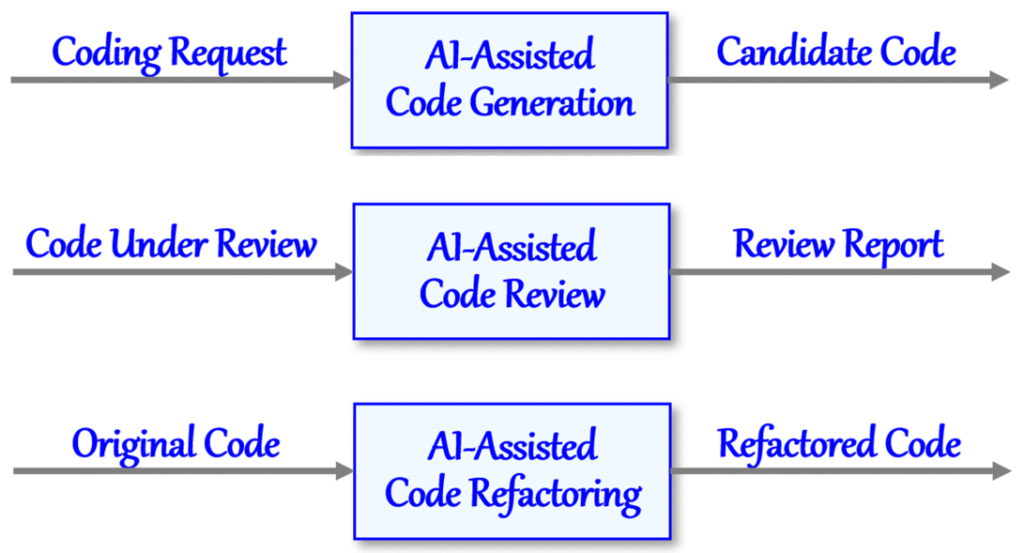
AI-assisted code generation helps developers produce candidate object-oriented code from requirements, design information, partial implementations, or natural-language instructions. The generated code can then be evaluated and refined before integration.
AI-assisted code review helps examine generated or existing code for correctness, object-oriented design quality, coding problems, and opportunities for improvement. Developers assess the findings and determine which corrections should be applied.
AI-assisted code refactoring helps improve the internal structure of existing code while preserving its intended behavior. It can support the identification of code smells, selection of refactoring strategies, and systematic improvement of class structures and object collaborations.
Together, these practices support a development approach in which AI accelerates programming while the developer retains responsibility for design intent, judgment, validation, and software quality.
For a comprehensive treatment of object-oriented programming concepts, their realization in C++, Java, and Python, and AI-assisted practices for code generation, code review, and code refactoring, see the book AI-Assisted Object-Oriented Programming.