
Software Architecture Basics
Software architecture provides the foundation for designing complex software systems. It defines how a system is structurally organized, how its design is represented through architectural views, and how architectural tactics are applied to satisfy functional and non-functional requirements. The resulting architecture provides a comprehensive and detailed design blueprint for system implementation.
1. What is Software Architecture
Software architecture has been defined in different ways, reflecting different perspectives on what aspects of a software system should be considered architectural. Some definitions emphasize syste`m structure and relationships among architectural elements, while others emphasize architectural decisions, stakeholder concerns, or quality attributes.
From a design-oriented perspective, software architecture is defined as follows:
Software architecture is the design of a system’s structure, architectural views, and architectural tactics aimed at fulfilling both functional and non-functional requirements. It provides a comprehensive and detailed design blueprint that serves as the foundation for system implementation.
This definition identifies three essential aspects of software architecture: structural design, architectural views, and architectural tactics.
2. Essential Aspects of Software Architecture
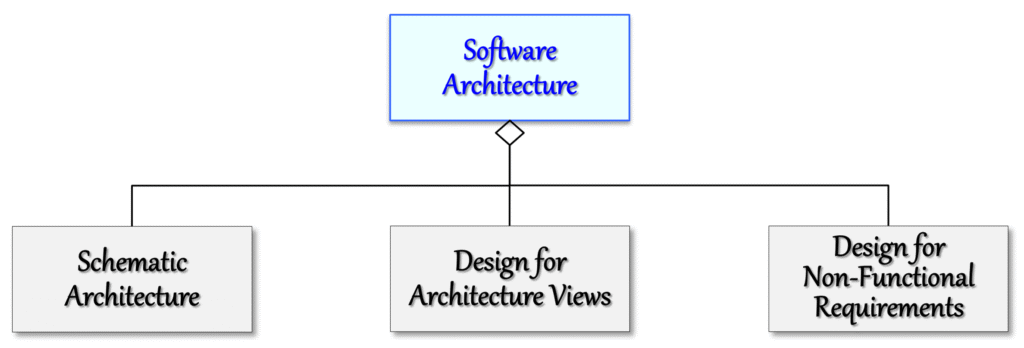
Software architecture is fundamentally composed of three core elements, as shown below.
Reproduced from Hands-on Software Architecture: Unified Architecture Process, Springer, 2025
Schematic architecture defines the structural organization of a software system in terms of its architectural elements, their responsibilities, relationships, interfaces, and interactions. It provides the structural framework for organizing the system and serves as the basis for developing the architectural views.
Architectural views represent the architecture from complementary perspectives. Each view addresses particular architectural concerns and provides information needed to understand, communicate, analyze, and implement the system. Together, the views provide a more complete representation of the architecture than a single structural model can provide.
Architectural tactics are focused design strategies used to address non-functional requirements and quality concerns. Tactics guide architectural decisions concerning qualities such as performance, availability, security, modifiability, scalability, and reliability.
3. Why Software Architecture Matters
Software architecture is the most critical design decision in software development. It establishes the fundamental structure of a system, defining its major components, their interactions, and the principles guiding their evolution. The architecture determines how the system will achieve essential quality attributes such as performance, reliability, scalability, and maintainability.
In modern large-scale and AI-enabled systems, architectural decisions directly influence not only technical outcomes but also organizational efficiency and product sustainability. A well-designed architecture enables teams to manage complexity, adapt to changing requirements, and support continuous evolution with minimal rework. Conversely, inadequate architectural design often leads to high maintenance costs, integration difficulties, and poor system performance.
Therefore, software architecture serves as the foundation for both design and implementation. It provides a shared understanding among stakeholders, guides detailed design and development, and ensures that the system’s structure remains consistent with its intended purpose throughout its lifecycle.
4. Software Architects
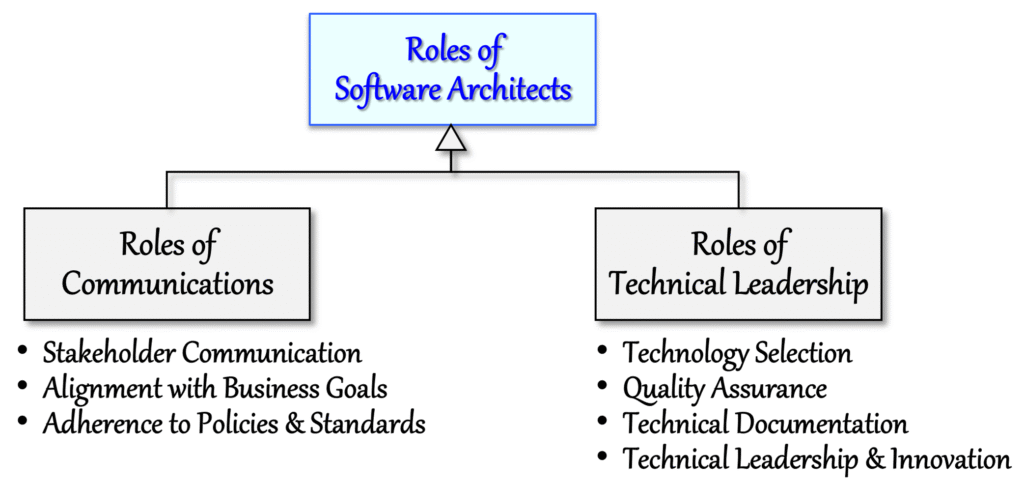
A software architect is a senior-level technical expert responsible for designing a system architecture that defines the overall structure, captures key design decisions across multiple architectural views, and incorporates strategies to meet both functional and non-functional requirements. The roles of software architects can be broadly categorized into two key areas as shown below:
Reproduced from Hands-on Software Architecture: Unified Architecture Process, Springer, 2025.
Roles of Communications
Software architects play a central communication role by connecting diverse stakeholders—business leaders, developers, and clients—throughout the project. They ensure that architectural decisions align with business objectives, clarify technical implications for non-technical audiences, and maintain compliance with organizational policies and standards. Effective communication enables shared understanding, reduces misalignment, and builds trust across all participants in the development process.
Roles of Technical Leadership
As technical leaders, software architects guide technology selection, establish quality assurance practices, and oversee architectural documentation. They drive innovation by exploring emerging technologies while ensuring that design choices remain robust and maintainable. Through their leadership, architects balance strategic vision with technical excellence, fostering a culture of disciplined engineering and continuous improvement across the organization.
5. Challenges in Software Architecture Design
Designing software architecture requires architects to make interdependent decisions under multiple and sometimes conflicting requirements and constraints. A design decision that improves one quality attribute may negatively affect another, and decisions made in one part of the architecture may have system-wide consequences.
Major challenges include understanding architectural requirements, managing system complexity, selecting appropriate architectural solutions, balancing functional and non-functional requirements, resolving design trade-offs, maintaining consistency among architectural decisions, and producing a design sufficiently complete and detailed to guide implementation.
6. Methodological Approach to Software Architecture Design
A software architecture design methodology is a systematic approach for developing, documenting, and evaluating a software architecture. It defines a structured set of activities, guidelines, work products, and decision procedures that guide architects from architectural requirements to a well-defined architectural solution. A methodological approach improves consistency, completeness, traceability, design quality, and repeatability, while reducing omissions, ad hoc decisions, and unnecessary rework.
The Unified Architecture Process (UAP) provides such a methodology. It organizes software architecture design into well-defined activities and work products, supporting systematic development, documentation, refinement, and evaluation of architectural solutions. By providing a disciplined and repeatable process, UAP helps architects address complex functional and non-functional requirements and produce architectures whose key decisions are explicit, justifiable, and traceable.
More about the Unified Architecture Process →UAP Overview