
The AI-Assisted OOP Book
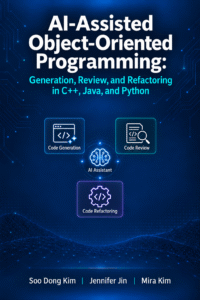
AI-Assisted Object-Oriented Programming:
Generation, Review, and Refactoring in C++, Java, and Python
Soo Dong Kim, Jennifer Jin, and Mira Kim
Forthcoming, 2027
This book presents an integrated treatment of object-oriented programming for the AI era. It combines a solid foundation in essential OOP concepts and constructs with practical guidance on AI-assisted object-oriented software development. Major OOP constructs are illustrated in C++, Java, and Python, while emphasizing the developer’s continuing responsibility for understanding, evaluating, and validating AI-generated solutions.
A major focus is on three systematic AI-assisted OOP practices: code generation, code review, and code refactoring. These practices are supported by structured copilot prompt templates, guidelines, and practical examples that help developers communicate programming intent more clearly and use AI assistance in a disciplined and repeatable manner.
This book is organized into three major parts.
Part I. Object-Oriented Paradigm and AI Assistance
This part establishes the conceptual foundation of the book. It explains the continuing importance of the object-oriented paradigm and introduces the emerging role of AI copilots in modern programming practice, including human-in-the-loop collaboration, prompt engineering, code generation, code review, and code refactoring.
Chapter 1. Object-Oriented Paradigm
Introduces the object-oriented paradigm, its core principles—including encapsulation, abstraction, inheritance, polymorphism, and composition—and its benefits and continuing significance in modern software development.
Chapter 2. AI Assistance in Object-Oriented Development
Introduces AI copilots and explains how they support object-oriented development through human-in-the-loop collaboration, prompt engineering, code generation, code review, and code refactoring.
Part II. Object-Oriented Programming Constructs
This part systematically examines essential object-oriented programming constructs in C++, Java, and Python. It provides the programming foundation for understanding and applying these constructs in the development of high-quality object-oriented software.
Chapter 3. Objects
Chapter 4. Classes
Chapter 5. Inheritance
Chapter 6. Polymorphism
Chapter 7. Dynamic Binding
Chapter 8. Abstract Class
Chapter 9. Interface
Chapter 10. Generic Class
Chapter 11. Reflection
Chapter 12. Object-Oriented Program Structure
Chapters 3–11 introduce the individual OOP constructs, explain their programming significance, and demonstrate their realization in C++, Java, and Python. Chapter 12 shows how these constructs work together within a complete object-oriented program.
Part III. AI-Assisted Object-Oriented Programming Practices
This part provides focused coverage of AI-assisted object-oriented programming practices, treating AI assistance as a systematic programming practice rather than merely a supplementary development tool.
Chapter 13. AI-Assisted Code Generation
Explains how AI copilots can generate candidate object-oriented code for major OOP constructs and complete programs using structured prompts, while maintaining developer responsibility for correctness and quality.
Chapter 14. AI-Assisted Code Review
Presents AI-assisted review of object-oriented code using systematic review criteria to identify defects, incomplete assumptions, poor programming decisions, and violations of object-oriented principles.
Chapter 15. AI-Assisted Code Refactoring
Presents a systematic AI-assisted refactoring process for identifying code smells, defining refactoring strategies, applying transformations, and validating that intended behavior is preserved while code quality is improved.
Beyond the Three Parts
The Epilogue, “Continuing Beyond This Book,” briefly introduces the object-oriented software development process, UML, and design patterns. Two appendices provide quick references to OOP concepts and constructs in C++, Java, and Python and to AI-assisted OOP prompt templates for code generation, code review, and code refactoring.